
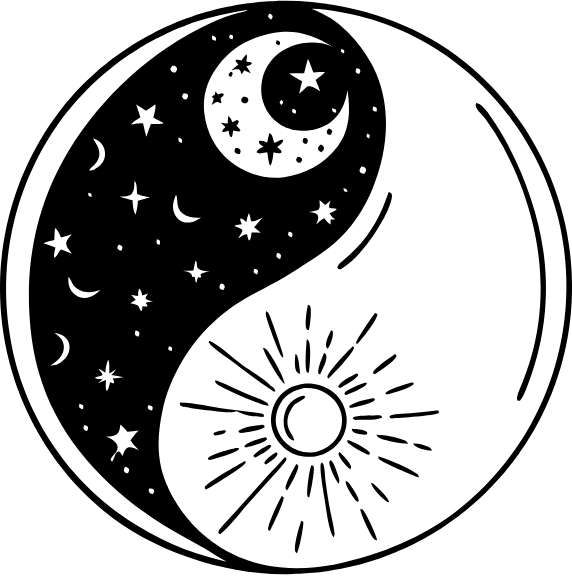
The balance between Yin and Yang is like an eternal, fluid and complementary dance between two vital forces. Yang represents action, light, movement, reasoning and expansion into the outer world. Yin expresses rest, welcome, silence, intuition and inner withdrawal.
When we live in harmony, the force of action (Yang) is fed and sustained by pause and restoration (Yin), and we alternate between doing and simply being.
What balance looks like
Someone who lives a dynamic balance between Yin and Yang is not static, but flexible and adaptable. That person does not suppress either force: they know which energy to access according to the need of the moment. They recognise that there will be more Yang days (which ask for expansion, communication and deliveries) and more Yin days (which ask for withdrawal, study and interiority), and move between them without losing their centre. These are the main traits of a presence in Yin-Yang harmony.
Action and rest: knowing how to do and how to be
- Action with purpose: can plan, focus, make decisions and put projects into practice without resorting to burnout or frantic hurry (conscious Yang).
- Rest without guilt: knows how to stop, slow down, be quiet and nourish themselves without anxiety about “not producing” (conscious Yin).
- Energy management: knows when to move forward with determination and when to step back and wait for the right time of things.
Emotional and relational
- Welcome and boundaries: is empathic, listens with genuine presence and welcomes others (Yin), but also knows how to say “no”, set clear boundaries and take a firm stand when needed (Yang).
- Emotional intelligence: can feel and welcome their own deep emotions without drowning in them (the Yin ability to feel plus the Yang ability to give shape and clarity).
- Vulnerability with courage: has the sensitivity to show vulnerability (Yin) together with the inner strength to sustain who they are (Yang).
Mental and cognitive
- Intuition and logic in dialogue: trusts their own intuitive perception, the “feeling” and the wisdom of the body (Yin), but uses logical reasoning, structure and critical discernment to validate and organise those perceptions (Yang).
- Big picture: moves well between the abstract and conceptual and the practical and achievable.
Alternating between doing and simply being.
When one side takes over
Both forces have a healthy expression and a form that shows up in excess. What follows are tendencies of behaviour described as a reference, not diagnoses.
Yin: receptive, introspective, nurturing
Associated with night, cold, water, rest, intuition and passive structure.
- Well integrated: excellent listening, empathy and sharp intuition; the ability to welcome, reflect and be patient; appreciation of solitude, silence and moments of rest.
- Signs of excess Yin (or deficiency of Yang): procrastination, apathy, excessive passivity, social isolation, melancholy and difficulty making decisions or taking action.
Yang: active, expansive, dynamic
Associated with day, heat, fire, movement, reason and outward action.
- Well integrated: focus on goals, strong willpower and the ability to execute; direct communication, leadership and dynamism; practicality, logical reasoning and enthusiasm.
- Signs of excess Yang (or deficiency of Yin): hyperactivity, anxiety, impatience, irritability, burnout and a tendency towards control or aggression.
Yin and Yang at a glance
| Aspect | More Yin | More Yang |
|---|---|---|
| Focus of attention | Inner world, feelings, reflection | Outer world, achievements, action |
| Pace of life | Slow, receptive, contemplative | Fast, focused, goal-oriented |
| Communication | Indirect, soft, welcoming | Direct, assertive, objective |
| Main challenge | Putting ideas into practice and setting limits | Knowing how to stop, relax and accept vulnerability |
How I use it in a session
In the mapping stage of an Energy Alignment, the balance between Yin and Yang is one of the two things I read with dowsing, alongside the chakras. The purpose is not to change who you are or to put you in a box, but to recognise where you are and what you need right now: more pause, or more movement.